Most people think their payslip already accounts for everything they're entitled to. The tax line gets calculated, the number lands in their account, and that feels like the end of the story.
For a lot of people, it isn't. The monthly deduction your employer makes only ever applies one relief, the flat personal relief. A handful of other reliefs exist under the law, and none of them reach your paycheck automatically. You have to claim them yourself, once a year.
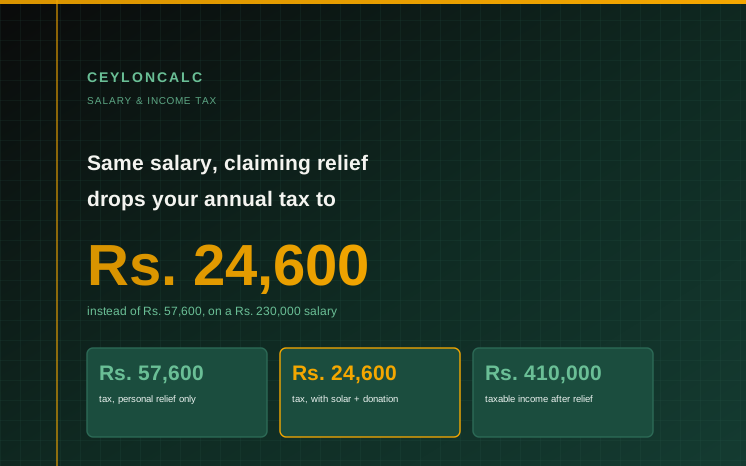
Take a salary of Rs. 230,000 a month, the same example used throughout this site. Using just the personal relief, that salary's annual taxable income comes to Rs. 960,000, and the annual tax works out to Rs. 57,600, exactly what the monthly PAYE table already withholds. That's what shows up on the payslip every month, and for most employees, it's the only number they ever see.
But the IRD's own Statement of Estimated Tax guide lists several other reliefs and qualifying payments that reduce taxable income further, none of which your employer's monthly withholding calculation ever applies.
Three are worth knowing about specifically.
Solar panel relief. If you've installed solar panels connected to the national grid, you can deduct up to Rs. 600,000 for the year of assessment, capped at your actual expenditure, or at loan repayments if the installation was financed.
Rent relief. If you earn rental income as an individual, 25% of that rental income is deductible before tax applies to it.
Qualifying payments (donations). Donations to approved charitable institutions are deductible, capped at whichever is lower: one-third of your taxable income, or Rs. 75,000. Donations to the government, the Consolidated Fund, or the President's Fund are treated separately and aren't subject to that same cap.
None of these are large or obscure loopholes. They're ordinary things many taxpayers already do, install solar, donate to a cause, rent out a property, that simply never get factored into the number withheld from a monthly salary.
Your employer's monthly APIT withholding is designed to be simple and automatic. It takes your salary, applies the personal relief and the progressive bands, and deducts a number, the same process shown in our PAYE bands guide. It has no way of knowing whether you installed solar panels in March or donated to a charity in October, because that information doesn't exist in payroll systems.
That's what the annual Statement of Estimated Tax and the final return are for. Filing it is how these reliefs actually reduce what you owe, and if too much was withheld monthly relative to your true annual liability once these reliefs are applied, filing is also how you get the difference refunded.
Same Rs. 230,000 monthly salary, Rs. 2,760,000 a year. Here's the difference between claiming just the personal relief, and claiming the personal relief plus a Rs. 500,000 solar installation and a Rs. 50,000 charitable donation.
Both figures stay entirely within the first 6% tax band, since even Rs. 960,000 is under the Rs. 1,000,000 threshold, which keeps the arithmetic simple here. The difference, Rs. 33,000, is money this person is legally entitled to keep, but only reaches them if they actually file the annual return and claim it.