CeylonCalcAll calculators
Tax

Sri Lanka's 2025/26 PAYE bands: what they actually mean for your salary

CC
CeylonCalc
Editorial Team
July 3, 20266 min read
Sri Lanka's 2025/26 PAYE bands: what they actually mean for your salary
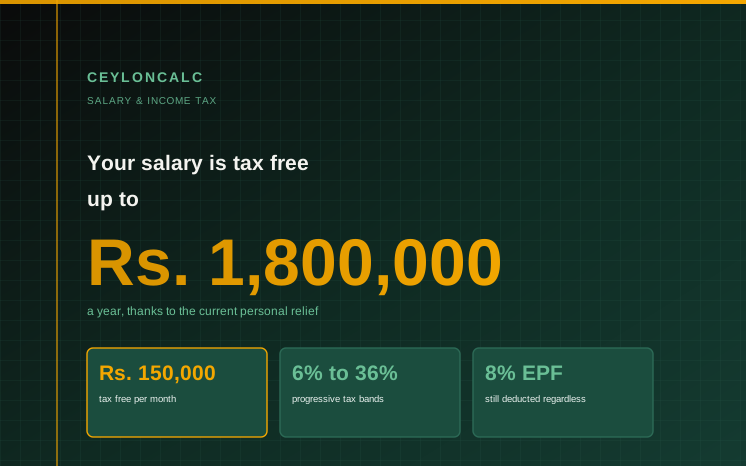
A salary of Rs. 150,000 a month pays zero income tax under the current PAYE bands, and a Rs. 230,000 salary pays just Rs. 4,800 a month, an effective rate of 2.1%.

Most people glance at the tax line on their payslip, notice it moved since last time, and move on without ever seeing the logic behind it. It feels like a black box, some percentage the bank or the payroll system decided on your behalf.

It isn't a black box. It's a public, published table, and once you see how it actually works, you can predict exactly what happens to your take-home pay at any salary level, not just the one you're on now.

01The bands are public, they're just never explained

If you have looked at your payslip and wondered why the tax line changes so much between one salary level and the next, the answer sits in a set of progressive tax bands that the Inland Revenue Department introduced through PN/IT/2025-01, effective from 1 April 2025. These are still the bands in force today. No new bands or rates have been introduced for the 2026/2027 tax year that started this April, so if you are reading this in 2026, this is the table your employer is actually using.

Tip

A salary of Rs. 150,000 a month currently pays zero income tax. A salary of Rs. 230,000 a month pays just Rs. 4,800 in monthly PAYE, an effective rate of 2.1% on the full salary.

02The annual tax bands

Taxable income (after relief)Tax rate
First Rs. 1,000,0006%
Next Rs. 500,00018%
Next Rs. 500,00024%
Next Rs. 500,00030%
Balance above Rs. 2,500,00036%

These figures come directly from PN/IT/2025-01. Note that the personal relief itself is not a band, it is an amount that is entirely tax free before any of these rates apply.

03What your employer actually uses each month

Employers do not wait until year end to apply these bands. They deduct tax monthly under the Advance Personal Income Tax (APIT) system, using a simplified monthly version of the same bands, published as Tax Table No. 01. This is the table that determines the number on your payslip.

Monthly regular incomeMonthly tax formula
Up to Rs. 150,000No tax
Rs. 150,000 to Rs. 233,3336% of income, less Rs. 9,000
Rs. 233,333 to Rs. 275,00018% of income, less Rs. 37,000
Rs. 275,000 to Rs. 316,66724% of income, less Rs. 53,500
Rs. 316,667 to Rs. 358,33330% of income, less Rs. 72,500
Above Rs. 358,33336% of income, less Rs. 94,000

The "less a fixed amount" structure looks unusual at first, but it exists so that the monthly deduction lines up exactly with what the annual bands would produce if you divided the year into twelve equal months. It is not a separate or different set of rules, it is the same bands expressed as a shortcut formula.

04Two salaries, worked out in full

Here is what this looks like in practice for two different monthly salaries, each with the standard 8% employee EPF contribution deducted as well.

Rs. 150,000 salaryRs. 230,000 salary
Gross annual salaryRs. 1,800,000Rs. 2,760,000
Personal reliefRs. 1,800,000Rs. 1,800,000
Taxable incomeRs. 0Rs. 960,000
Annual taxRs. 0Rs. 57,600
Monthly PAYERs. 0Rs. 4,800
Monthly EPF (8%)Rs. 12,000Rs. 18,400
Net take-homeRs. 138,000Rs. 206,800
Effective tax rate0.0%2.1%

The Rs. 150,000 salary sits exactly at the personal relief threshold, so its entire annual income of Rs. 1,800,000 is tax free. Only the 8% EPF deduction reduces take-home pay, bringing it down to Rs. 138,000.

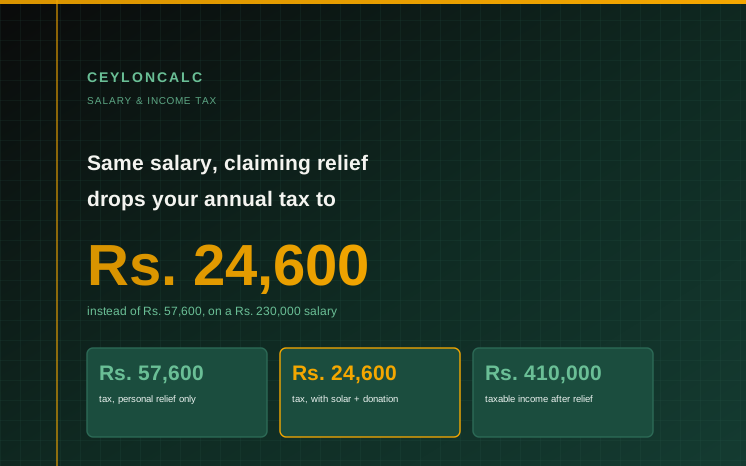
The Rs. 230,000 salary crosses into taxable territory. Its taxable income of Rs. 960,000 falls entirely within the first band (since it is under Rs. 1,000,000), so the whole amount is taxed at 6%, giving Rs. 57,600 a year, or Rs. 4,800 a month. Applying the monthly shortcut formula directly gives the same answer: 6% of Rs. 230,000 is Rs. 13,800, less Rs. 9,000, equals Rs. 4,800.
Methodology note: figures calculated using the current IRD annual tax bands and monthly withholding table, applying the Rs. 1,800,000 personal relief and 8% employee EPF contribution, as confirmed by PN/IT/2025-01, APIT Tax Table No. 01, and the Central Bank of Sri Lanka's EPF contribution rates.

Work out your own salary using the
Advertisement

05Frequently asked questions

Sources

  1. PN/IT/2025-01:

    the Inland Revenue Department's notice introducing the current personal income tax bands and Rs. 1,800,000 personal relief, effective 1 April 2025.

  2. APIT Tax Table No. 01:

    the Inland Revenue Department's official monthly withholding table used by employers to calculate PAYE deductions under the Advance Personal Income Tax system.

  3. Central Bank of Sri Lanka EPF contribution rates:

    confirms the 8% employee and 12% employer EPF contribution rates.

  4. IRD Tax Calendar 2026:

    the Inland Revenue Department's published calendar of filing and payment deadlines for the 2026 tax year.

Related articles
Advertisement