Income tax in Sri Lanka is complicated on purpose. Progressive bands, a personal relief, different rates depending on how much you earn, all of it designed to tax higher incomes more heavily than lower ones.
EPF and ETF aren't like that at all. They're the simplest calculation on your entire payslip, a fixed percentage of your gross salary, the same rate no matter how much you earn.
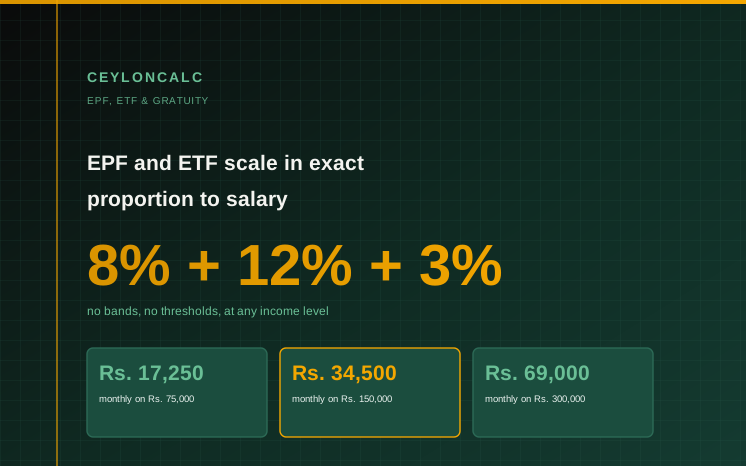
Under the EPF Act No. 15 of 1958, Section 10(1) sets your own contribution at 8% of your gross monthly earnings, deducted directly from your salary. Section 10(2) sets your employer's contribution at 12%, paid on top, not deducted from what you receive. Separately, Section 16(1) of the ETF Act No. 46 of 1980 requires your employer to contribute a further 3%, with no deduction from your pay at all.
That's the entire calculation. No bands, no thresholds, no exemptions based on income level. Multiply your gross salary by 8%, 12%, and 3%, and that's exactly what goes into your EPF and ETF accounts every month.
Here's the calculation applied at three salary levels, to show how directly it scales.
Double the salary from Rs. 150,000 to Rs. 300,000, and every single figure in the table exactly doubles too. Compare this to income tax, where doubling a salary can push part of it into a much higher tax band, and the contrast is clear. EPF and ETF are proportional by design, income tax is deliberately progressive.
Because the rate never changes regardless of salary, EPF and ETF contributions are one of the easiest parts of a paycheck to project forward. A salary increase translates into a predictable, proportional increase in retirement contributions, with no need to check which band or threshold applies. That predictability is also what makes EPF balances so sensitive to salary growth over a career, since every raise doesn't just increase this month's contribution, it increases every contribution for as long as that higher salary continues.