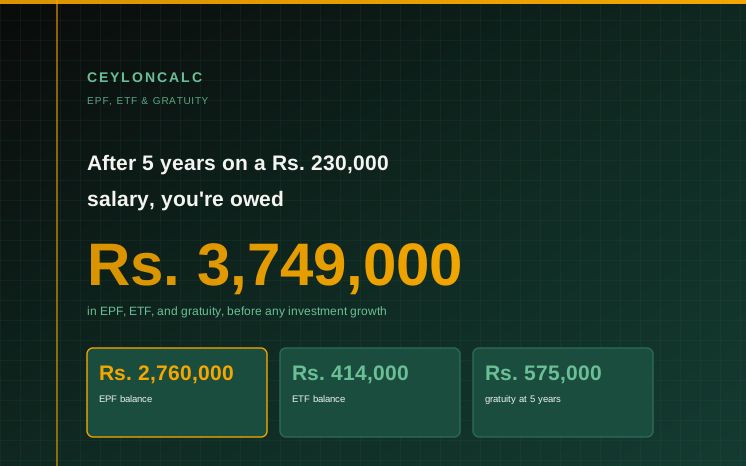
On a Rs. 230,000 monthly salary, five years of EPF, ETF, and gratuity add up to Rs. 3,749,000, and that's before any investment growth.
Most people know EPF, ETF, and gratuity as a single blur, three acronyms that show up on a payslip or get mentioned together at a farewell party. They feel like one thing.
They aren't. Each is a separate law, with its own contribution rate, its own rules for who qualifies, and its own way of paying out. Understanding them separately is the only way to actually know what you're owed, and when.
01Three acronyms, three separate laws, three different rules
Here's the short version before the detail. On a Rs. 230,000 monthly salary, after 5 years of continuous service, an employee has built up Rs. 2,760,000 in EPF, Rs. 414,000 in ETF, and is owed Rs. 575,000 in gratuity, a combined Rs. 3,749,000, and that's before any investment growth on the EPF and ETF balances.
Tip
After 5 years on a Rs. 230,000 salary, EPF, ETF, and gratuity together add up to Rs. 3,749,000, before any investment growth is applied.
02EPF: the one you and your employer both pay into
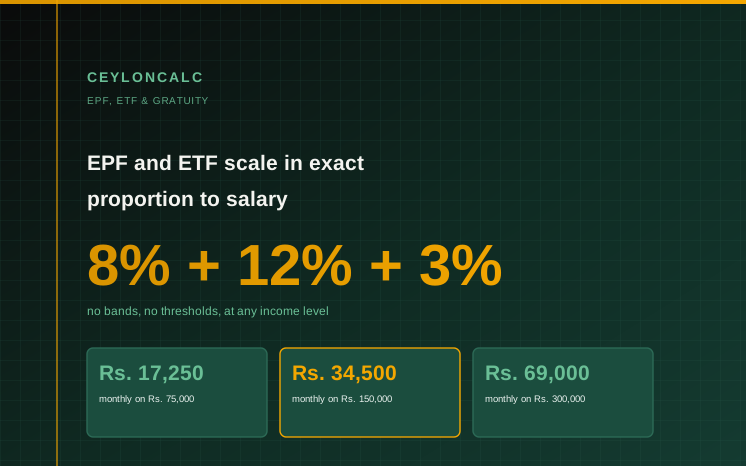
The Employees' Provident Fund is governed by the EPF Act No. 15 of 1958. It's the only one of the three where the employee contributes directly. Under Section 10(1), 8% of your monthly earnings is deducted from your salary. Under Section 10(2), your employer adds a further 12% on top, for a combined 20% going into your EPF account every month. On a Rs. 230,000 salary, that's Rs. 18,400 from you and Rs. 27,600 from your employer, Rs. 46,000 a month in total.
EPF balances earn an annual interest rate declared by the Central Bank each year, historically averaging around 9%, though the actual rate varies year to year. This is why an EPF balance grows to more than just the sum of what went in, the longer the money sits, the more of the final balance is interest rather than contributions.
03ETF: the one only your employer pays
The Employees' Trust Fund, established under Section 16(1) of the ETF Act No. 46 of 1980, works differently. There is no employee deduction at all, your employer alone contributes 3% of your monthly earnings. On a Rs. 230,000 salary, that's Rs. 6,900 a month, entirely funded by your employer, with nothing taken from your pay.
Like EPF, ETF balances also earn an annual return, so the same growth effect applies here too, just at a smaller starting contribution.
04Gratuity: the one you don't contribute to at all, and don't get until you leave
Gratuity is different again. It isn't a savings account that grows every month, it's a lump-sum entitlement calculated once, at the point your employment ends. It's governed by the Payment of Gratuity Act No. 12 of 1983, and two conditions have to be met before it applies at all. Under Section 5, your employer must have employed 15 or more workmen in the 12 months before your termination, and you must have completed at least 5 years of continuous service with that employer. If either condition isn't met, gratuity generally doesn't apply.
For a standard monthly-salaried employee, Section 6(2)(a) sets the formula: half a month's salary for each year of completed service, based on your last drawn salary. On a Rs. 230,000 salary at exactly 5 years, that's (Rs. 230,000 ÷ 2) × 5, or Rs. 575,000, paid as a single lump sum, typically at resignation, retirement, or termination.
Note
Gratuity has a hard eligibility line. Leave one day before your 5th anniversary, and the entitlement generally doesn't apply at all, not a reduced amount, none.
05Putting it together: a full worked example
Here's what all three look like together, on a Rs. 230,000 monthly salary over 5 years of continuous service, shown both with no investment growth (just the raw contributions) and with a 9% annual return applied to the EPF and ETF balances, roughly the historical average.
No growth (raw contributions)
With 9% annual growth
EPF balance
Rs. 2,760,000
Rs. 3,469,510
ETF balance
Rs. 414,000
Rs. 520,427
Gratuity
Rs. 575,000
Rs. 575,000
Total
Rs. 3,749,000
Rs. 4,564,937
The difference between the two columns, Rs. 815,937, is pure compound growth, money that came from investment returns rather than anyone's paycheck. That's roughly 18% of the total retirement benefit at just 5 years. Gratuity stays identical in both columns, since it isn't invested, it's a fixed formula applied once at the point of leaving, not a balance that grows over time the way EPF and ETF do.
Tip
Methodology note: figures calculated using CeylonCalc's EPF/ETF and Gratuity calculator, on a Rs. 230,000 monthly salary with 5 years of continuous service, 0% salary growth, and a 9% annual EPF/ETF return, compounded monthly. Contribution rates confirmed by the EPF Act No. 15 of 1958 and Section 16(1) of the ETF Act No. 46 of 1980. Gratuity formula and eligibility confirmed by the Payment of Gratuity Act No. 12 of 1983.
Run your own salary and service length through the
Section 5 sets the eligibility thresholds (employers with 15+ workmen, employees with 5+ completed years of service), and Section 6(2)(a) sets the half-month-salary-per-year formula for monthly-rated employees.