There's a quiet assumption most Sri Lankan credit card holders make: that paying the minimum every month means you're handling your debt. You're not in arrears. The bank isn't calling. That feels like control.
It isn't. The minimum payment is one of the most expensive financial habits you can have, not because it costs you more this month, but because of what it costs you over the next seven and a half years. Yes, seven and a half years. That's what the arithmetic says, and most people have never been shown it.
Both Bank of Ceylon and Commercial Bank charge 26% per annum on outstanding credit card balances, confirmed in the Bank of Ceylon Credit Card Key Facts Document and Commercial Bank's published Interest Calculation Policy. Divided across 12 months, that's 2.17% charged against whatever you owe, every single month.
Here's what that looks like when you sit down with actual numbers.
Say your balance is Rs. 150,000. Your card's minimum payment rule (standard at most Sri Lankan banks) is 5% of the outstanding balance, with a floor of Rs. 1,200 so payments don't disappear to nothing as the balance shrinks. Your minimum this month is Rs. 7,500.
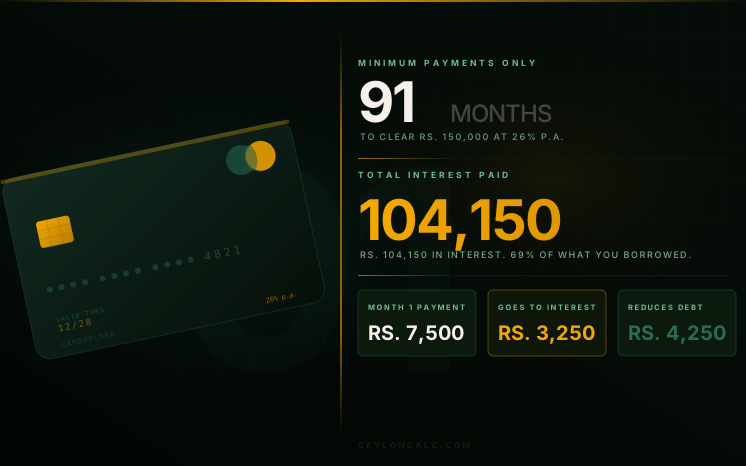
That sounds like progress. Here's the part that stings: of that Rs. 7,500, exactly Rs. 3,250 is pure interest. Not a rupee of it reduces your debt. It's just the monthly cost of having borrowed Rs. 150,000 at 26% per annum. The remaining Rs. 4,250 is what actually comes off the balance.
You pay Rs. 7,500. Your balance moves from Rs. 150,000 to Rs. 145,750.
And then next month, the same thing happens. Slightly smaller payment, because the balance is slightly smaller, but almost the same proportion going to interest first. This is the trap: not one dramatic event, just the same slow bleed, month after month, with the bank collecting interest before your principal moves at all.
Run the full simulation on that Rs. 150,000 balance (26% annual rate, 5% minimum, Rs. 1,200 floor, no extra spending on the card) and you get a result that most people find genuinely difficult to believe the first time they see it.
Months to pay off: 91. That's 7 years and 7 months of minimum payments to clear a balance you could have run up in an afternoon of shopping.
Total interest paid: Rs. 104,150. Total amount paid back to the bank: Rs. 254,150, which is Rs. 104,150 more than you ever received in your hand.
To put it another way: you borrowed Rs. 150,000, and the bank will collect Rs. 254,150 from you before calling it done. The interest alone is 69% of your original balance.
Think about the age version of this. Open the card at 30. Make every minimum payment faithfully, never miss one, never add to the balance. You'll be 37 and a half before it clears.
The reason the timeline stretches so far is the same reason the first month's math is so discouraging: because minimum payments are percentage-based, they fall as the balance falls. In month one you're paying Rs. 7,500. By year four that's down to around Rs. 1,950. By year six you're brushing against the Rs. 1,200 floor. The bank is collecting less each month, but there's still a balance, and interest is still compounding on it. You're paying, but you're paying less and less just as your debt needs you to push harder."
Under the CBSL Credit Card Operational Guidelines No. 01/2010, issued under the Payment and Settlement Systems Act No. 28 of 2005, card issuers are required to communicate any revisions to interest rates and charges to all active customers. What the guidelines don't require (and what banks almost never volunteer) is a projection of what minimum payments will cost you over the full life of your balance. That number would be uncomfortable to show.
Nothing about minimum payment structure is accidental. A percentage-based minimum is engineered to shrink at the same rate as your debt, which is the mathematical opposite of a personal loan or leasing arrangement. With a loan, you pay a fixed amount each month, the debt falls on a predictable schedule, and you know exactly when you're done.
With credit cards, you're never shown a payoff date. That's intentional. From the bank's perspective, a customer who consistently makes minimum payments is ideal: not in default, not a collections problem, and generating interest revenue for close to a decade. The CBSL Credit Card Operational Guidelines No. 01/2010 set out disclosure requirements for Sri Lankan card issuers, but projecting the total cost of minimum payment servicing over the life of a balance isn't one of them. You have to work that out yourself, or use a calculator like the one below.
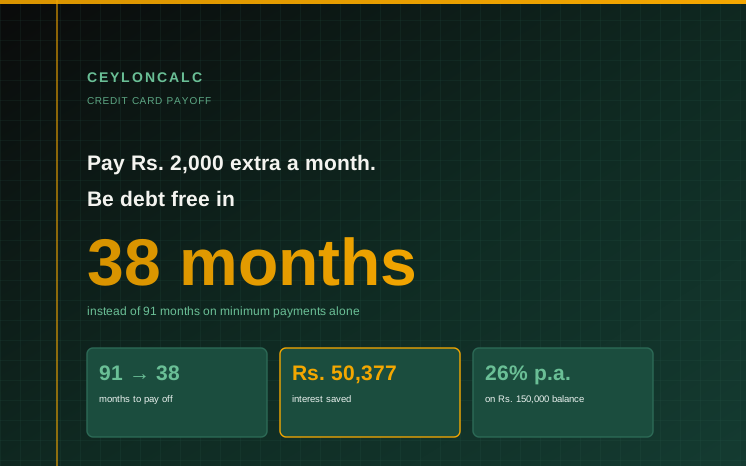
The fix isn't complicated. Paying even Rs. 2,000 extra per month on top of the minimum cuts that 91-month timeline down to 38 months and saves Rs. 50,377 in interest, on exactly the same starting balance, at exactly the same rate. We go through that in detail in the next article. But the starting point is knowing what your balance is costing you right now.