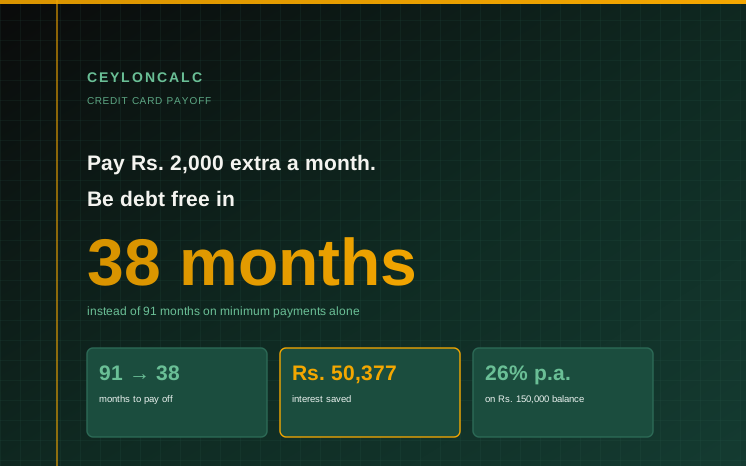
Add Rs. 2,000 a month to your minimum credit card payment and you clear a Rs. 150,000 balance in 38 months instead of 91, saving Rs. 50,377 in interest along the way.
There's a quiet relief that comes with paying more than the minimum on a credit card, even by a little. It feels like you're getting ahead, even if you couldn't say by how much.
You are getting ahead, and by more than it feels like. A modest extra payment doesn't just chip away at the balance a bit faster. It changes the entire shape of the debt, cutting years off the timeline and tens of thousands of rupees off what you'll ultimately pay in interest. Most people never see the actual numbers behind that, so here they are.
01A little extra now beats a lot extra later
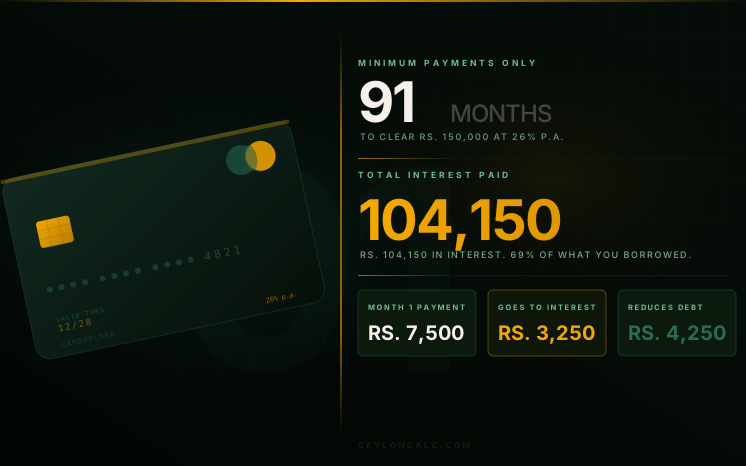
In our previous article, why minimum payments are a trap, we worked through what happens if you only ever pay the minimum on a Rs. 150,000 credit card balance. The answer was not encouraging. At a typical Sri Lankan card rate of 26% p.a. and a minimum payment of 5% of the balance (or Rs. 1,200, whichever is higher), it takes 91 months, just over seven and a half years, to clear the debt. Along the way you pay Rs. 104,150 in interest, almost 70% of the original balance, on top of what you borrowed.
The good news is that the fix does not require a windfall. A modest, consistent extra payment on top of the minimum changes the outcome dramatically, and most of that change happens fast. The first bit of extra money you commit does more work than the next bit, which is exactly why it is worth starting small rather than waiting until you can afford a large extra payment.
Tip
Adding Rs. 2,000 a month on top of the minimum payment cuts the payoff time on a Rs. 150,000 balance from 91 months to 38 months, and saves Rs. 50,377 in interest.
02The three scenarios, side by side
Using the same starting balance and rate as Article 1, here is what changes when you add a fixed extra amount to your monthly payment, on top of whatever the minimum works out to be.
Payment plan
Time to pay off
Total interest paid
Interest saved vs minimum only
Minimum only (5% or Rs. 1,200 floor)
91 months
Rs. 104,150
Rs. 0
Minimum + Rs. 2,000 extra
38 months
Rs. 53,773
Rs. 50,377
Minimum + Rs. 5,000 extra
22 months
Rs. 32,819
Rs. 71,331
Notice what happens between the two extra-payment tiers. The first Rs. 2,000 a month saves Rs. 50,377 and 53 months, roughly Rs. 25 saved for every extra rupee paid. Going from Rs. 2,000 to Rs. 5,000, an additional Rs. 3,000 a month, only adds another Rs. 20,954 in savings and 16 more months off the timeline, roughly Rs. 7 saved for every extra rupee in that second tier. The first bit of extra payment delivers far more value than the next bit. That is not a reason to skip extra payments, if anything it is the opposite: even a small extra payment captures most of the available benefit, so there is no need to wait until you can afford a large one.
03Why the first extra rupee does more than the next one
Interest on a credit card balance is calculated on whatever principal remains outstanding. Every rupee you pay above the minimum comes straight off that principal, which means every month afterward, 26% p.a. is being calculated on a smaller number. The saving is not just the extra payment itself, it is every future month of interest that would otherwise have been charged on that portion of the balance.
That is also why the marginal effect fades. The first Rs. 2,000 a month cuts the payoff time from 91 months down to 38, which means it is preventing interest across all of those 53 months that no longer happen. The next Rs. 3,000 a month is only working against a much shorter remaining timeline, 38 months instead of 91, so there is simply less future interest left for it to prevent.
This is also why minimum payments are such a trap in the first place. When you pay only the minimum, a large share of that payment is consumed by interest before it even touches the principal, especially in the early months. Extra payments bypass that entirely, since they go straight to principal.
This part is a matter of personal financial planning rather than a fixed rule, so treat it as a starting point rather than advice tailored to your situation. Common sources of a manageable extra payment include redirecting a portion of an annual bonus, trimming one recurring discretionary expense, or simply rounding your payment up to the nearest thousand each month. Even an extra Rs. 1,000 compounds in your favour over time, since the mechanism described above applies at any extra amount, not just Rs. 2,000 or Rs. 5,000.
the Central Bank of Sri Lanka's operational guidelines for licensed banks issuing credit cards, covering disclosure requirements, interest calculation, and cardholder protections.
BOC's published Key Facts Document confirming a 26% per annum interest rate on outstanding credit card balances, issued under CBSL consumer disclosure requirements.